The trigger for most Hyattsville termite calls is a swarm. On warm, damp afternoons in late March through May, winged reproductives push out of a crack in a basement slab or a foundation joint and pile up at the…
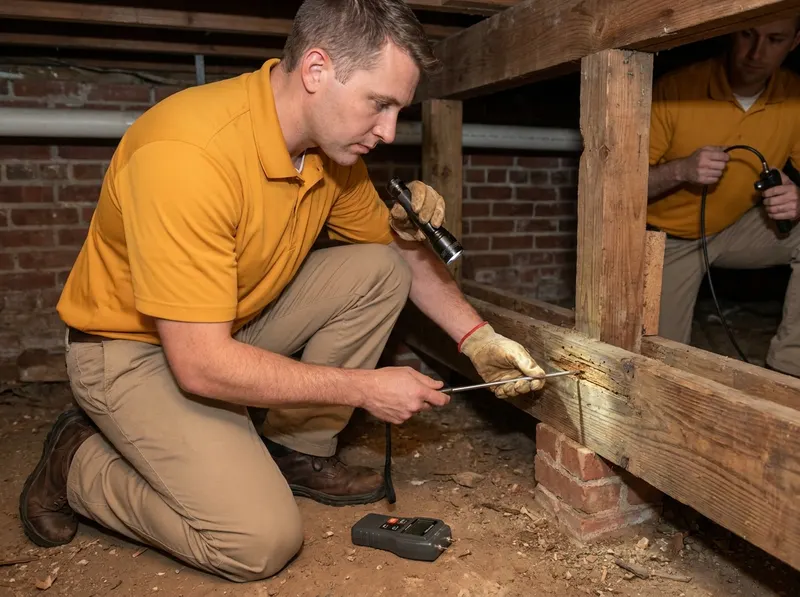
The trigger for most Hyattsville termite calls is a swarm. On warm, damp afternoons in late March through May, winged reproductives push out of a crack in a basement slab or a foundation joint and pile up at the nearest light — a basement window well, a stairwell bulb, the inside of a storm door. Homeowners in Historic Hyattsville and along the older blocks near Driskell Park see them first because the housing stock there is brick over aging foundations with wood framing sitting close to grade. A swarm indoors means a colony is already established in or under the structure; a swarm outdoors near a stump or fence post means a colony is nearby and the structure needs checking, not panic.
An inspection fits when you have evidence but no diagnosis: wings on a sill, a soft spot in a door casing, a real-estate closing that requires wood-destroying insect findings, or a stretch of years with no one having looked. Skip straight to a treatment conversation only when live termites and mud tubes are already visible and identified — otherwise the trade-off runs the wrong way, because treatment specifications depend on what the inspection measures. Trench-and-treat volumes, the number of drill points through a slab or a garage floor, and whether a crawlspace needs attention at every pier are all set by the linear feet of foundation and the construction type recorded during the visit. An inspection that produces measurements and a diagram is what keeps a later treatment quote from being a guess.
Hyattsville construction shapes what the inspection can reach. Split-levels and 1950s ranches in University Hills, Castle Manor and Hyattsville Hills tend to have accessible basements and exposed joists, which is the easiest case — most framing can be probed directly. Rowhouses and semi-detached blocks in the Arts District and West Hyattsville share party walls, so the inspection notes soil grade and downspout discharge on both sides of the shared wall, since a colony feeding under a neighbor's foundation is not stopped by a property line. Finished basements in Queens Chapel Manor, Kirkwood, Lewisdale and the Hyattsville side of Riverdale Heights hide the sill plate behind drywall and paneling; the report says plainly which areas were obstructed rather than implying the whole structure was seen. Homes on the low ground toward the Northwest Branch carry more soil moisture against foundations, and mulch beds piled above the brick course, buried siding, and firewood stacked against a wall are the conditions that keep coming up in that part of Prince George's County.
Landlords and small property managers get findings written for a file: date, unit, areas inspected, areas not accessible, conditions observed. That documentation matters when a tenant reports damage or when work needs to be coordinated across two units on the same wall. Termite work in Maryland is regulated, so ask any company for credentials before treatment starts — before that point, an inspection is an inspection, and you are entitled to hear exactly what was found and what was not. If nothing active turns up, the useful output is the list of conducive conditions to fix: regrade the mulch, extend the downspouts, move the woodpile, and re-check next spring.
Every job gets a firm, written price after a free on-site visit.
Tell us about your termite inspection job in Hyattsville and we'll send a clear, written quote — usually the same day.
 Veyronix Pest Control Service