Hyattsville gives rats three things they need: food, water, and soft ground to dig in. The Northwest Branch corridor through Driskell Park, the storm-drain network feeding it, and the tributary trail edges are natural…
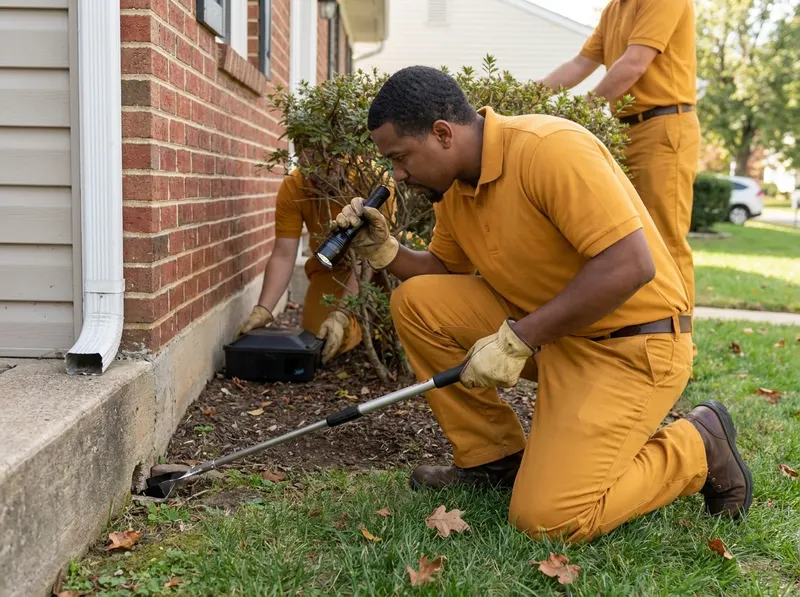
Hyattsville gives rats three things they need: food, water, and soft ground to dig in. The Northwest Branch corridor through Driskell Park, the storm-drain network feeding it, and the tributary trail edges are natural rat habitat, so homes in Historic Hyattsville, Kirkwood and Riverdale Heights that back onto low, damp yards see burrows appear along foundation walls, under porch slabs, beneath sheds, and inside ivy or English-ivy beds. Along the Route 1 side of the Arts District, restaurant dumpsters and alley cans support colonies that then push into nearby basements when a container is moved or a lot gets cleared. In Lewisdale, West Hyattsville and Queens Chapel Manor, older brick foundations with settled mortar joints, open utility penetrations, and unsealed basement window wells give rats an entry they can use without chewing. A rat needs a gap of roughly half an inch to pass, and it will gnaw a smaller one wider.
Rat control is the right call — instead of mouse service — when you see droppings the size of a raisin or larger, burrow holes two to four inches across with a smooth worn lip, greasy rub marks along baseboards or joists, or gnawed corners on wood doors and plastic pipe. Mouse work uses different bait quantities, different trap placement, and a tighter sealing standard, so the two programs are not interchangeable. The trade-off worth knowing: a single knockdown visit is cheaper up front, but rats reproduce fast and re-invade along established runways, so one visit alone rarely ends an established burrow system. A multi-visit trapping program plus exclusion work costs more and settles the problem, because it removes the population and takes away the route.
Multi-family and rowhouse blocks need a coordinated approach. Rats travel shared party walls, common basements, and joined crawlspaces, so treating one unit while the adjoining unit stays untouched simply moves the activity next door. For small landlords near Hyattsville Crossing Metro Station and along the Ager Road side of West Hyattsville, we document conditions unit by unit, note which openings are structural versus housekeeping, and provide the paperwork rental managers need when a tenant raises a habitability complaint. Exterior conditions get the same honesty: overflowing cans, bird feed, fallen persimmon and mulberry fruit, and pet food left on back steps in University Hills or Castle Manor will keep a colony fed no matter what we place in a bait station, and we will say so in writing rather than sell another visit.
Rodenticides in Maryland are regulated products, and any outdoor bait we place goes into tamper-resistant stations secured against children and pets. Where a home has small kids, dogs, or a nearby school route like the blocks around Northwestern High School, we can run trap-only interior work and keep bait to secured exterior stations. Prep is simple, and we explain it before the first visit: clear access to the basement perimeter, move stored boxes eighteen inches off the foundation wall, and hold off on your own bait so we can read the traps accurately. Pests out. Entry points sealed.
Every job gets a firm, written price after a free on-site visit.
Tell us about your rat control job in Hyattsville and we'll send a clear, written quote — usually the same day.
 Veyronix Pest Control Service